
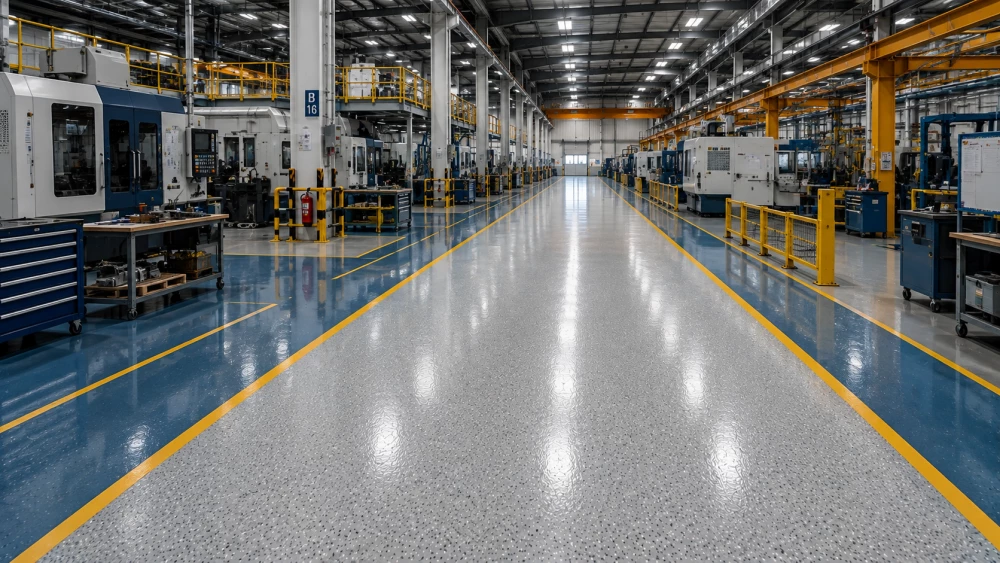
Factory Flooring in Ealing
Get in TouchWe install epoxy resin flooring for factories and manufacturing facilities in Ealing.
Factory floors operate under demanding conditions. Machinery, production equipment, forklifts, pallet trucks, chemicals and repeated foot traffic can all affect the floor surface. The resin system needs to be selected around the processes taking place within the factory.
Epoxy Flooring for Manufacturing Facilities
Epoxy resin systems provide a durable finish over prepared concrete floors.
They can be installed in:
Production halls
Assembly areas
Manufacturing lines
Machine areas
Engineering facilities
Packing areas
Internal transport routes
Goods-in areas
Storage areas
A factory does not necessarily require one flooring specification throughout. Production processes and traffic levels should determine what is installed in each area.
What Does a Factory Floor Need to Withstand?
The main consideration is how the floor will actually be used.
A manufacturing floor can be subjected to a combination of:
Heavy machinery
Fixed production equipment can create concentrated loads on the underlying concrete.
Forklift traffic
Repeated vehicle movements create wear, particularly along established routes and turning areas.
Impact and abrasion
Tools, components, pallets and manufacturing activity can cause mechanical damage.
Process liquids
Oils, lubricants, cleaning products and manufacturing chemicals can come into contact with the floor.
Pedestrian traffic
Production staff require suitable walking surfaces around machinery and working areas.
These conditions determine the required resin build-up and surface finish.
Heavy-Duty Factory Resin Flooring Ealing
Higher-build resin systems can be specified for manufacturing areas exposed to intensive use.
The appropriate system depends on the level of mechanical loading rather than the term "heavy duty" alone.
Factors to assess include:
Machinery
Forklifts and pallet trucks
Production volume
Impact
Abrasion
Chemical exposure
Cleaning regime
Existing concrete condition
The concrete substrate also needs to be capable of supporting the loads imposed on it. Resin flooring is a surface system and does not compensate for an unsuitable structural slab.
Production Line Flooring
Production lines create defined working areas with repeated patterns of traffic.
Flooring around machinery and assembly stations may experience different wear from the rest of the factory.
A resin flooring specification can account for individual production zones, including areas around fixed equipment, pedestrian workstations and material handling routes.
Different colours can also be incorporated where production areas need to be visually separated.
Forklift Routes and High-Traffic Areas
Forklifts and other material handling equipment can produce concentrated wear in predictable parts of a factory.
These commonly include:
Main traffic routes
Turning points
Doorways
Loading areas
Production intersections
Storage routes
Areas around machinery
The frequency, weight and wheel type of factory vehicles should be considered when selecting the resin system.
Workplace traffic routes should also provide a surface suitable for the vehicles and pedestrians using them.
Factory Floor Coatings
Where operating conditions permit, epoxy floor coatings can be applied to existing concrete to provide a protective finished surface.
Higher-build systems may be more appropriate where the floor experiences greater levels of mechanical wear.
The options can include self-smoothing epoxy systems, high-build coatings and heavier-duty resin finishes.
The existing concrete needs to be assessed before deciding which system is appropriate.
Oils, Chemicals and Process Fluids
Chemical exposure varies significantly between factories.
Manufacturing floors may encounter:
Oils
Lubricants
Coolants
Cleaning chemicals
Process liquids
Other substances used during production
Epoxy systems have different chemical resistance characteristics.
The flooring specification should therefore be based on the substances present, their concentration, frequency of contact and expected exposure time.
Chemical resistance should not be assumed simply because a floor is epoxy resin.
Slip-Resistant Factory Flooring
Manufacturing processes can introduce contamination onto the floor.
Where oils, liquids or other contaminants cannot be completely prevented, an appropriate slip-resistant surface may be required.
Textured resin finishes can provide additional grip in selected production areas.
The required finish should balance slip resistance with practical cleaning requirements. A more heavily textured surface can require more intensive cleaning than a smooth resin floor.
Factory Floor Zoning and Line Marking
Factory floors can be divided into clearly defined operational areas using coloured resin and line marking.
Markings can identify:
Pedestrian walkways
Forklift routes
Production zones
Workstations
Machinery areas
Storage zones
Keep-clear areas
Loading areas
The layout should correspond with the actual movement of employees, vehicles and materials through the factory.
Existing Factory Floor Problems
A worn factory floor should be assessed before another coating is applied.
Typical defects include cracked concrete, damaged joints, worn coatings, surface contamination and localised deterioration around heavily trafficked areas.
Simply coating over these problems can affect the performance of the new floor.
Repairs and preparation should be completed according to the condition of the substrate.
Preparing Concrete for Epoxy Flooring
Mechanical preparation creates a suitable surface for the resin system to bond to.
Depending on the existing floor, work can include:
Diamond grinding
Shot blasting
Existing coating removal
Crack repairs
Joint repairs
Concrete repairs
Removal of contamination
Smoothing or levelling
Moisture assessment
Preparation requirements are established from the condition of the existing concrete and the flooring system being installed.
Refurbishing Factory Floors in Ealing
Factory floor refurbishment often needs to account for production schedules.
Where site conditions and the selected resin system allow, the project can be divided into separate areas so that sections of the factory remain operational.
Planning should account for preparation, installation, curing periods, equipment access and the point at which pedestrian or vehicle traffic can return to the completed floor.
Factory Epoxy Flooring Installers Ealing
We provide commercial epoxy resin flooring for factories and manufacturing facilities throughout Ealing.
Projects can include floor preparation, concrete repairs, epoxy coatings, heavy-duty resin systems, slip-resistant finishes, production zoning and line marking.
Send us details of the manufacturing process, approximate floor area, existing surface and the types of traffic using the floor. We can use this information to determine the flooring requirements for the project.
We cover Ealing (Greater London)