
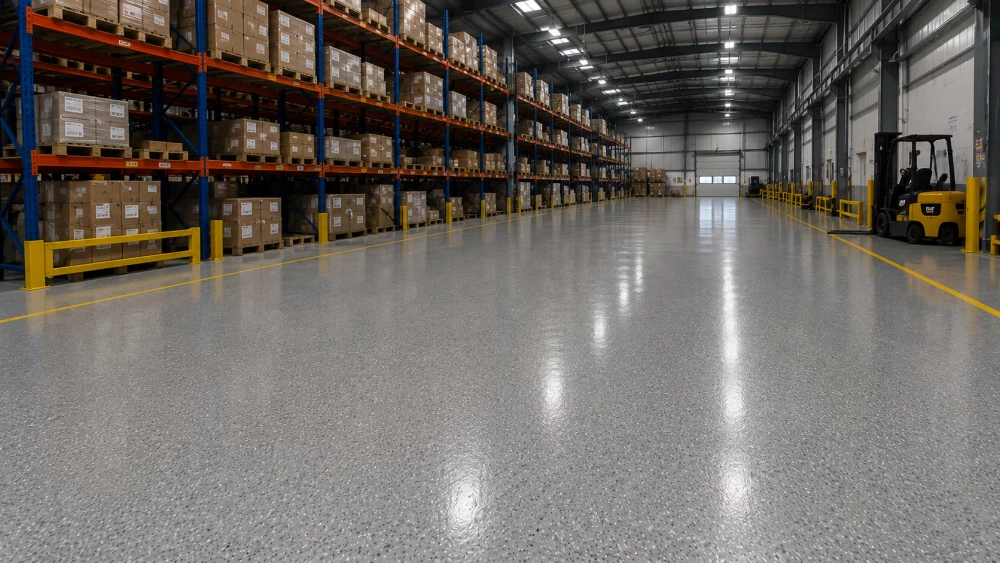
Warehouse Flooring in Wath upon Dearne
Get in touchWe install commercial epoxy resin flooring for warehouses and distribution facilities in Wath upon Dearne.
Warehouse floors are exposed to repeated forklift movements, pallet trucks, pedestrian traffic, stored goods and loading activity. The epoxy system should be specified around the actual traffic, wear and operating conditions within the building.
Request a Warehouse Flooring Quote
Epoxy Resin Flooring for Warehouses
Epoxy resin flooring creates a hard-wearing finish over a suitably prepared concrete substrate.
Warehouse epoxy systems can be used across:
Storage areas
Picking and packing areas
Forklift routes
Racking aisles
Dispatch areas
Goods-in areas
Loading zones
Distribution centres
Different areas of the warehouse may require different system thicknesses or finishes.
Warehouse Floors and Forklift Traffic
Forklift traffic places repeated mechanical stress on warehouse flooring.
The highest wear commonly occurs on established traffic routes, turning points, intersections and areas around loading operations.
When specifying flooring for forklift use, the following should be considered:
Forklift type and weight
Frequency of movements
Turning areas
Wheel type
Pallet truck traffic
Existing concrete condition
Joints and transitions
Higher-build epoxy systems can be used where a basic floor coating would not provide sufficient durability.
Worn and Dusty Concrete Warehouse Floors
Existing concrete can deteriorate under warehouse traffic.
Common problems include surface wear, dusting, cracks, damaged joints and failed previous coatings. These defects should be assessed before applying a new epoxy system.
The preparation method depends on the condition of the floor. Mechanical preparation can include diamond grinding or shot blasting, followed by repairs where required.
A sound, appropriately prepared substrate is necessary for the resin system to bond correctly.
Warehouse Floor Coatings Wath upon Dearne
Not every warehouse requires the same resin build-up.
A floor subject primarily to pedestrian traffic and light storage can have different requirements from a distribution warehouse operating forklifts throughout the day.
Available systems can include:
High-build epoxy coatings
Used to provide a durable protective finish over prepared concrete.
Self-smoothing epoxy flooring
Creates a smooth resin surface where a higher-build continuous finish is required.
Heavy-duty resin systems
Suitable for areas subject to more intensive mechanical wear and traffic.
Slip-resistant resin finishes
Textured systems can be specified for areas where contamination creates an increased slip risk.
The system should be selected after considering how the warehouse operates.
Loading Bay Flooring
Loading and dispatch areas can experience some of the most demanding conditions within a warehouse.
These areas may be exposed to vehicle movements, pallet handling, impacts, dirt and moisture entering from outside.
Flooring around loading bays should account for the type of traffic and expected contamination. Additional slip resistance may be appropriate where floors are regularly exposed to water or other contaminants.
Epoxy Flooring Under Warehouse Racking
Warehouse racking creates concentrated static loads on the underlying concrete slab.
The resin finish itself should not be treated as a structural solution for inadequate concrete. The condition and suitability of the substrate need to be considered separately from the surface coating.
Epoxy flooring can be installed around racking layouts to provide a durable finished surface across storage and picking areas.
Where existing racking remains in place, the installation method should account for uprights, floor fixings and restricted areas.
Warehouse Floor Repairs
A new epoxy coating should not simply cover significant defects in an existing warehouse floor.
Preparation and repair work can include:
Crack repairs
Joint repairs
Local concrete repairs
Removal of failed coatings
Grinding
Shot blasting
Surface levelling
Removal of contamination
Moisture assessment
The extent of preparation depends on the existing substrate and the resin system being installed.
Slip-Resistant Warehouse Flooring
Slip resistance should be considered where the warehouse floor is likely to become contaminated.
Water, oil and other liquids can change the slip characteristics of a floor. The appropriate surface finish therefore depends on the conditions in which people will actually walk.
Textured resin finishes can provide additional grip in selected areas such as loading zones, entrances, ramps and operational areas exposed to contamination.
A heavily textured finish is not automatically appropriate for every warehouse because surface texture also affects cleaning.
Warehouse Floor Line Marking
Epoxy flooring can be combined with floor markings to define how different parts of the warehouse are used.
Line marking can identify:
Pedestrian walkways
Forklift routes
Racking aisles
Picking zones
Loading areas
Storage locations
Keep-clear areas
Vehicle routes
Clear markings can help separate pedestrian and vehicle movements within busy warehouse environments.
Refurbishing an Operational Warehouse
Warehouse flooring does not always need to be installed across the entire building at once.
Depending on the selected resin system and site conditions, works can be divided into operational zones.
This can allow sections to be prepared, repaired and coated while other areas remain available for storage or distribution.
Curing times, traffic routes and access requirements need to be considered when planning phased works.
Warehouse Epoxy Flooring Contractors Wath upon Dearne
We provide warehouse epoxy flooring installation in Wath upon Dearne for storage facilities, logistics centres and distribution warehouses.
Projects can include substrate preparation, concrete repairs, epoxy coatings, heavy-duty resin systems, slip-resistant finishes and line marking.
Send us the approximate floor area, photographs of the existing floor and details of the traffic using the warehouse. We can then determine the appropriate flooring requirements and provide a quotation.
Get a Quote for Warehouse Epoxy Flooring in Wath upon Dearne
We cover Wath upon Dearne (South Yorkshire)